Postpaid vs SIM-Only in Singapore: The Real Cost

Neither is automatically cheaper. To compare fairly, add a SIM-only plan's two-year cost to the price of the phone bought outright, then compare that total against the handset contract's full two-year cost — upfront payment, monthly fees and device instalments included.
On this page (4 sections)
“Postpaid or SIM-only?” really means “do I want a phone bundled into the contract, or do I just want the line?” In Singapore many SIM-only plans are themselves postpaid, so here “postpaid” is shorthand for a handset-bundled contract: it combines mobile service with a device purchase, subsidy or payment arrangement, and the duration and payment structure vary by provider. SIM-only is the line on its own — no handset, and often no contract, though some SIM-only plans do carry a minimum term. Neither is universally cheaper; it depends on the phone you want and how long you keep your plan.
How to compare them fairly
The trap is comparing a postpaid monthly price (which includes a phone) against a SIM-only monthly price (which does not). To compare like with like, work out the total two-year cost of each route:
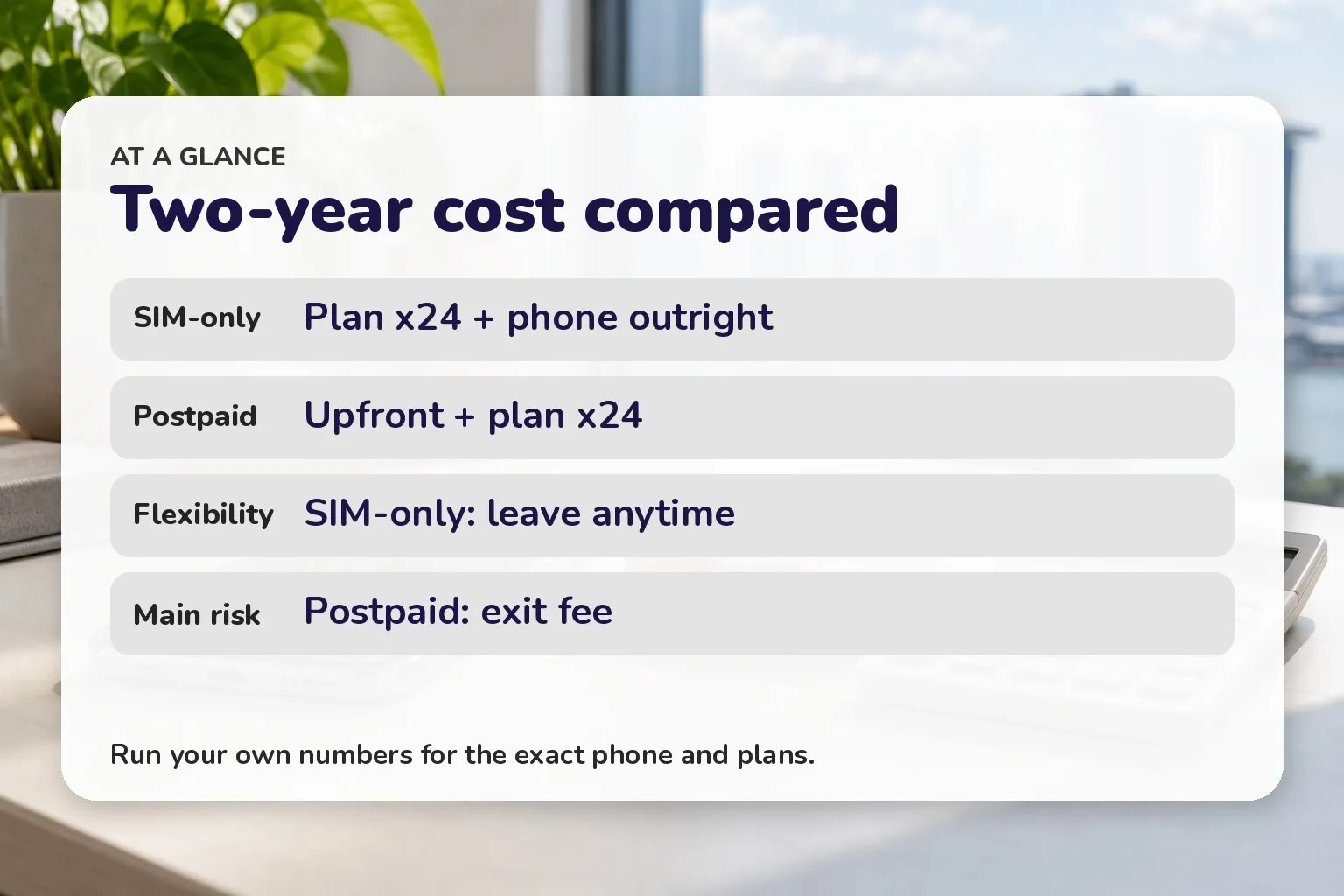
Comparing the true two-year cost.
- SIM-only route: (SIM-only monthly price × 24) + the phone bought outright + any mandatory fees.
- Handset-contract route: all upfront charges + (service-plan monthly price × 24) + any separate device instalments and mandatory fees − guaranteed rebates. Confirm quoted prices include GST.
Whichever total is lower wins — and a contract-free SIM-only plan also leaves you free to switch whenever a cheaper one appears (check the minimum term and notice first).
| Factor | Handset contract (“postpaid”) | SIM-only |
|---|---|---|
| Phone included | Yes, via subsidy or instalments | No — buy it separately |
| Contract | Commonly 12–36 months | Often none, but some have a minimum term |
| Flexibility to switch | Locked until contract ends | Switch when a better plan appears (check notice) |
| Best for | People who want a new flagship and perks | People who have a phone or buy outright |
| Main risk | Early-termination charges, remaining device payments or lost discounts | Possible notice period, minimum term or a separately financed phone |
Illustrative example
The figures below are illustrative, to show the method — they are not current prices. Always use real quotes for the specific phone and plans you are considering.
Say you want a phone that costs $1,200 outright.
- SIM-only route: a $15/month SIM-only plan over 24 months is $360, plus the $1,200 phone = $1,560 total, and you can switch plans when a better one appears (subject to any notice).
- Postpaid route: $300 upfront for the phone on contract, plus $45/month for 24 months ($1,080) = $1,380 total, but you are locked in for two years.
In this illustration postpaid is cheaper overall because the device subsidy is large — but if you would have chosen a $12/month SIM-only plan and a $500 phone, SIM-only wins easily. The point is to run your numbers, not trust the monthly headline.
When each one wins
Postpaid tends to win when: you want a current flagship phone, the subsidy is genuinely large, and you are confident you will keep the line for the full term.
SIM-only tends to win when: you already have a phone, you buy phones outright, your usage is modest, or you value the freedom to switch when prices drop.
Before you sign a postpaid contract
- Check the early-termination terms — these may be early-termination charges, remaining device payments or recovery of discounts, and vary by provider. If there is any chance you will leave early, this matters.
- Confirm the total you will pay, not just the monthly figure.
- Decide whether bundled perks (roaming, streaming) are things you will actually use.
If flexibility and a low steady price matter most, start with the best SIM-only plans framework, then rank your shortlist with the SIM-only plan picker. If you are weighing a telco that also offers home internet, see whether bundling mobile and broadband changes the maths. Prices change often — confirm current figures on the provider’s own page before committing.
Sources
- IMDA — telecommunication services and consumer information — Infocomm Media Development Authority (as of October 2026)