Best SIM-Only Plans in Singapore: How to Compare

The best SIM-only plan is the one with the lowest cost for the data and calls you actually use — not the biggest headline data bundle. Compare the total cost over a set period for your real usage, check whether the promo price is permanent or jumps after a few months, and check for any contract lock-in before you sign up.
The best SIM-only plan in Singapore is simply the one that costs the least for the data and calls you use — a plan with 100GB is not “better” if you only ever use 15GB. This guide is a framework for comparing contract-free plans honestly, because the ranking changes every month as promotions come and go.
We do not publish a live “cheapest plan” table here, because those prices move weekly and a stale number is worse than none. Instead, here is exactly how to compare, and the fine print that decides whether a cheap-looking plan really is cheap.
Work out your real usage first
Before you look at a single plan, check your last three phone bills or your phone’s data-usage screen:
- Data: your typical monthly GB — check the last three months on your bills or your phone’s data-usage screen, since usage varies widely, especially with video and hotspot use.
- Local calls and SMS: many plans now bundle generous or unlimited minutes, so this rarely decides it.
- Roaming or IDD: only relevant if you travel or call overseas.
Buy for your normal month plus a little headroom, not your worst month ever.
Compare on effective price per GB
The most useful number is the total cost for the data you actually need over a set period — for example 12 months of subscription plus any mandatory fees and likely top-ups, measured at the long-term price, not the intro price. Use price per included GB (the price divided by the data included) only as a secondary check, since a large allowance you never use can look deceptively cheap per GB.
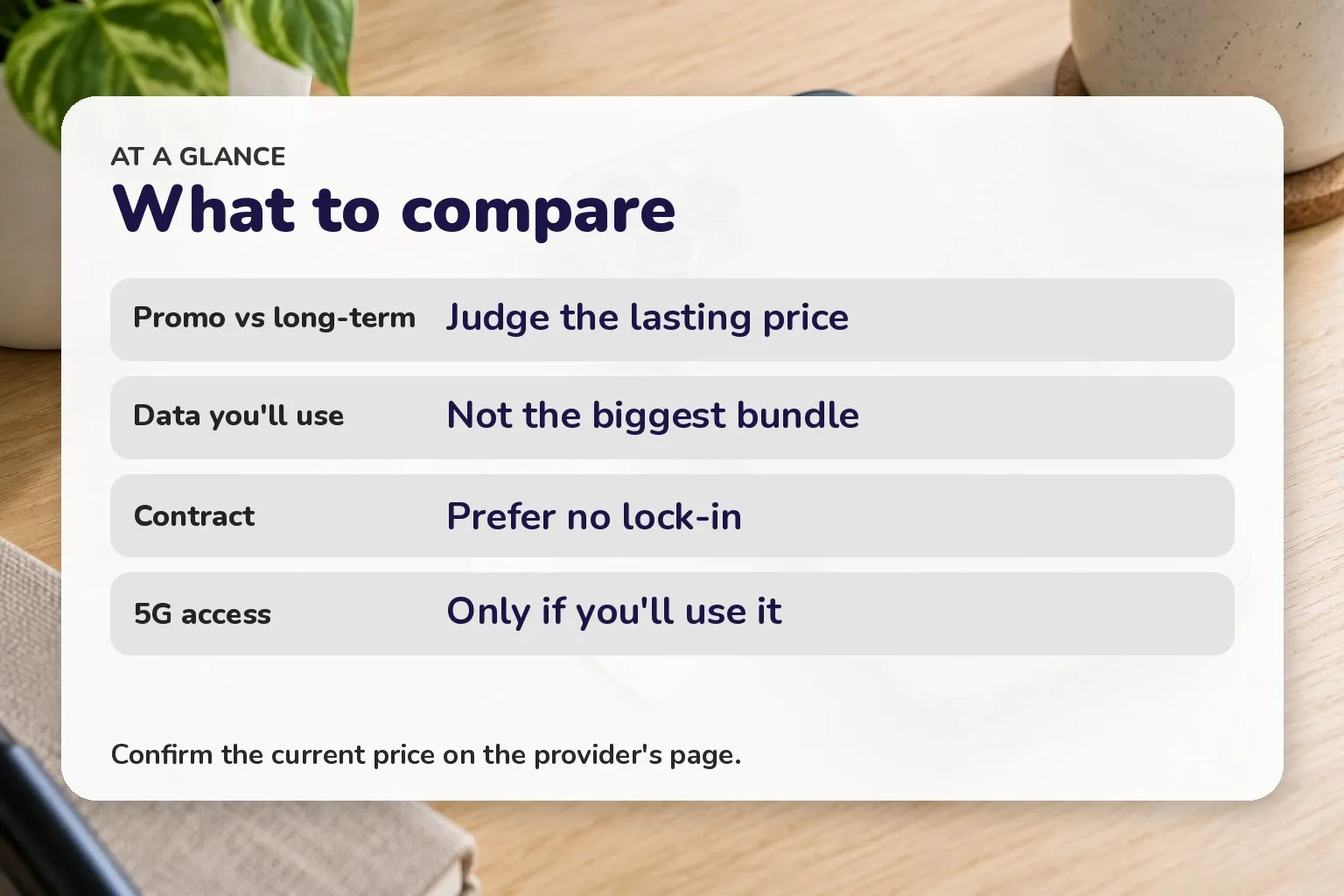
How to compare SIM-only plans honestly.
| What to check | Why it matters |
|---|---|
| Price after the promo ends | Many plans advertise a low rate for 3–12 months, then step up. Judge the long-term price. |
| Data you will really use | Paying for 100GB and using 15GB means your real cost per GB is high. |
| Contract length | “SIM-only” usually means no contract. If a cheap price needs a 12- or 24-month lock-in, factor in the exit cost. |
| Extra-data charges | Check whether going over means a throttle, an auto-purchased top-up, or a hard stop. |
| 5G access | Some cheaper plans are 4G only or charge extra for 5G — only pay for it if you will actually use it. |
Networks and MVNOs
Singapore has four mobile network operators — Singtel, StarHub, M1 and Simba — plus many MVNOs (virtual operators) that lease capacity on one of those networks. All four operators must meet IMDA’s nationwide outdoor 4G coverage standard, so outdoor coverage is broadly similar — but indoor coverage and performance on your usual routes can still differ. An MVNO may also have different speed caps, 4G/5G access, roaming and features from its host network, and real-world performance varies by location and congestion. If reliability matters to you, check which network an MVNO rides on before switching.
You can keep your number
Switching provider does not mean a new number. Under IMDA’s full mobile number portability framework, porting is often free and can complete in about one business day, though some providers quote up to 1–3 working days and may charge a small administrative fee — confirm the fee and timeframe with the new provider. It works for both postpaid and prepaid lines. Keep your old SIM active until the port finishes. If you are moving to an eSIM line, see what to prepare in our eSIM guide.
SIM-only vs postpaid
If you want a new phone bundled in, a postpaid contract can look convenient — but you pay for the phone over 24 months, often at a higher total cost. We break the maths down in Postpaid vs SIM-only. If you travel, also weigh roaming add-ons against a travel eSIM in our eSIM guide.
A simple decision rule
- Note your typical monthly data.
- Shortlist 3–4 plans that cover it with a little headroom.
- Compare the long-term monthly price, not the intro price.
- Prefer no contract unless a locked-in plan is clearly cheaper over its full term.
- Keep your number and port when the new SIM is ready.
Illustrative example: if Plan A is a steady $12/month for 30GB and Plan B is $8/month for 6 months then $18/month for 100GB, a 15GB user pays less over a year with Plan A — even though Plan B’s headline looks bigger and its intro price looks cheaper.
Prices and promotions change constantly. Always confirm the current price and terms on the provider’s own page before you sign up — and see how we track plan prices for where our figures come from.
Sources
- IMDA — telecommunication services and consumer information — Infocomm Media Development Authority (as of October 2026)
- Full Mobile Number Portability media release — Infocomm Media Development Authority (as of October 2026)