Is Bundling Mobile and Broadband Worth It?

A bundle is worth it only if its all-in cost — mobile plus broadband together — is lower than the best separate plans you would otherwise choose, not just lower than the same provider's own non-bundle prices. Weigh the lost flexibility too.
On this page (5 sections)
Telcos love bundles: take your mobile line and home broadband (sometimes TV too) from one provider and get a discount. Sometimes that genuinely saves money. Often it just makes a provider’s own plans look cheaper than they are while quietly tying you down. The honest test is simple arithmetic.
The only comparison that matters
On price alone, a bundle wins only if its all-in cost is lower than the best separate plans you would otherwise pick — not lower than the same provider’s non-bundle prices. Providers frame bundle savings against their own standalone rates, which may already be beatable elsewhere. Price is only part of it, though: weigh convenience, service quality and genuinely useful inclusions separately.
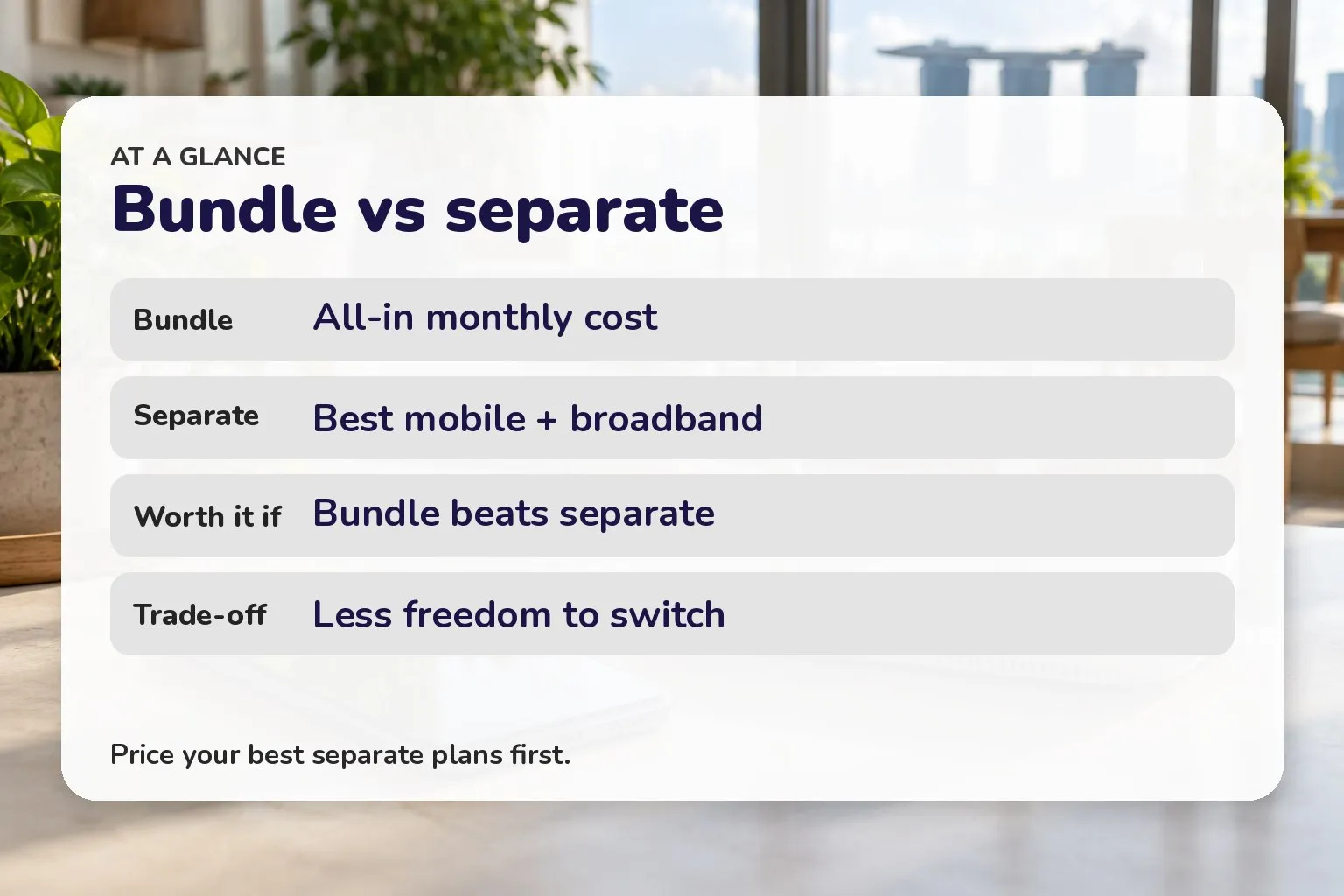
How to test whether a bundle really saves.
So compare:
- Bundle route: the bundle’s total monthly cost (mobile + broadband together), at the long-term price.
- Separate route: your best stand-alone mobile plan + your best stand-alone broadband plan, each chosen on its own merits.
If the separate route is cheaper or close, the bundle’s “discount” is an illusion. Compare the total cost over the same period — all recurring charges including GST, plus compulsory one-off and equipment fees, minus any rebates or credits — not just the headline monthly figure.
Work it through
- Pick your best mobile plan using the SIM-only comparison framework.
- Pick your best broadband plan using the broadband comparison framework.
- Add those two monthly costs — that’s your separate-route benchmark.
- Compare the bundle’s total against it, at the price you’ll pay after any promo.
Illustrative example: a bundle is advertised at $75/month for mobile + 1Gbps broadband. Your best separate choices are a $15 SIM-only plan and a $38 broadband plan = $53/month. Here the bundle costs $22/month more despite the “discount”, because cheaper standalone options exist. But if your best separate plans added up to $80, the bundle would save you $5/month — and you’d weigh that against the lock-in.
The hidden cost: flexibility
Bundling often places both services under linked contracts. That can mean:
- You can’t easily switch just the mobile line when a better SIM-only deal appears.
- Cancelling one service can trigger an early-termination charge, end a bundle discount or reprice the remaining service, depending on the provider’s terms — check the Critical Information Summary for each component.
- A promotional price may increase after the stated introductory period, so note the start date, end date and post-promo price.
Flexibility has real value — the ability to switch a cheap SIM-only plan every few months can beat a modest bundle discount over time.
When a bundle does make sense
- The genuine saving (versus your best separate plans) is meaningful and lasts the whole contract.
- You want one bill and one provider for simplicity, and value that convenience.
- The bundle includes multi-line or multi-service discounts you’d actually use (e.g. several family lines).
Bottom line
Don’t take the word “bundle discount” at face value. Price your best separate plans first, then see if the bundle genuinely beats them after promos and lock-in. For how we source the prices behind these comparisons, see how we track plan prices. Always confirm current bundle terms on the provider’s own page before signing.
Sources
- IMDA — telecommunication services and consumer information — Infocomm Media Development Authority (as of October 2026)