eSIM in Singapore: How It Works and Who Offers It
An eSIM is a digital SIM built into your phone: instead of inserting a plastic card, you load a plan by scanning a QR code or through the telco's app. Singapore's main telcos and many MVNOs offer eSIMs for supported phones.
On this page (5 sections)
An eSIM (embedded SIM) is a digital version of the SIM card, built into your phone. Instead of sliding in a plastic card, you load a mobile plan onto the phone itself — usually by scanning a QR code or tapping through the telco’s app. Once activated, it works like a physical SIM for the services included in your plan: converting or porting an existing line can keep your number, while a new line may get a new number, and some travel eSIMs are data-only.
Why people use eSIM
- No physical card to collect, insert, swap or lose.
- Fast activation — some providers let you start a plan within minutes online, without waiting for a card in the post.
- Dual SIM made easy — many phones can run a physical SIM and an eSIM at once, or two eSIMs, so you can keep your Singapore line while adding a data plan abroad.
Does your phone support eSIM?
Not every phone does. As a rough guide, most recent iPhones and many flagship Android phones (recent Samsung Galaxy, Google Pixel and others) support eSIM, while older handsets and some very budget models are physical-SIM only. The reliable way to check is your phone’s settings (look for an “Add eSIM” or “Add mobile plan” option) or the manufacturer’s specifications for your exact model.
How activation usually works
- Choose a plan that offers an eSIM (a new line, or when you switch and keep your number).
- Complete sign-up and identity verification with the provider.
- The provider issues an eSIM profile — typically a QR code to scan, or an activation inside their app.
- Your phone downloads the profile and the line goes live. If you ported your number, the old SIM stops working once the port completes — usually by the next working day under IMDA’s portability rules.
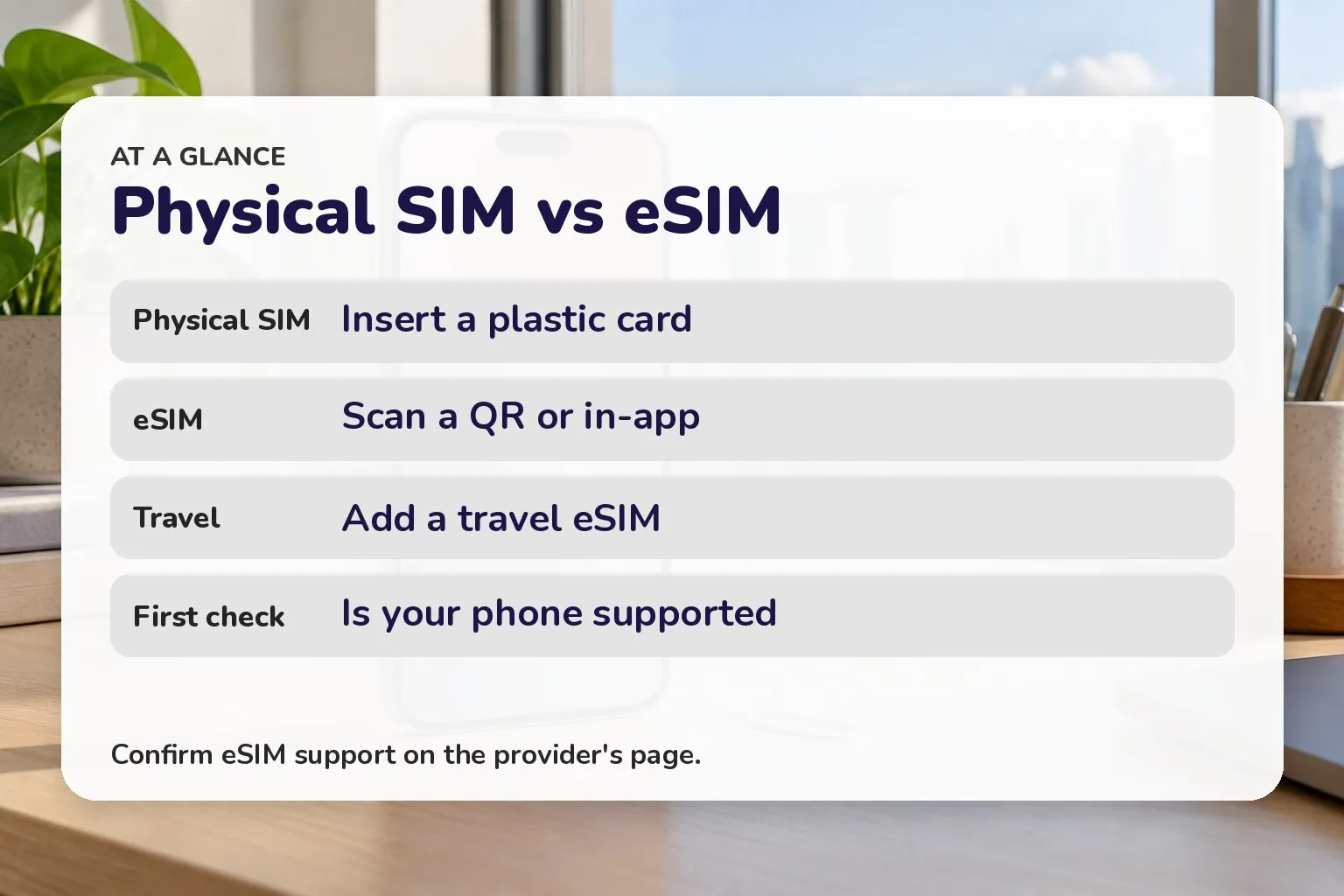
How an eSIM differs from a physical SIM.
| Physical SIM | eSIM | |
|---|---|---|
| Form | Plastic card you insert | Digital profile on the phone |
| Getting it | Collect or wait for delivery | Scan a QR code / in-app, often instant |
| Swapping phones | Move the card across | Re-download or transfer the profile |
| Travel | Buy a local SIM abroad | Add a travel eSIM without removing your home line |
eSIM and switching or travelling
Because the eSIM profile is installed on the phone, changing phones may mean transferring, re-downloading or requesting a replacement profile from the provider. Built-in phone-to-phone transfer is not supported by every Singapore provider, so check the provider’s instructions before deleting the old profile. When travelling, a separate travel eSIM lets you use overseas data while your Singapore number stays reachable on the other slot. Keep mobile data and data roaming off for the Singapore line unless you need it, select the travel eSIM as your data line, and check your home provider’s roaming charges for any calls and SMS — a travel eSIM is often cheaper than a roaming add-on for data-heavy trips, though roaming can be simpler for light use.
The catch to watch
The main friction with eSIM is phone changes and borrowing a friend’s handset in an emergency — you can’t just pop the card out. Check your provider’s replacement process in advance and keep your account-recovery details somewhere other than the phone; reissue may be through an app, website, support channel or shop, and a fee may apply. Otherwise, for most people on a supported phone, eSIM is simply a faster, tidier version of the same plan.
Choosing the plan itself works the same way whether it is eSIM or physical — start with how to compare SIM-only plans. Availability and terms vary by provider, so confirm eSIM support on the provider’s own page before signing up.
Sources
- IMDA — telecommunication services and consumer information — Infocomm Media Development Authority (as of October 2026)
- Full Mobile Number Portability media release — Infocomm Media Development Authority (as of October 2026)