Best Home Broadband Plans in Singapore: How to Compare
The best broadband plan is the one with the lowest effective monthly cost over the whole contract, after you subtract any free gift's real value and account for the price after the promo ends. Headline speed matters less than most people think — for a typical home, a 1Gbps plan is plenty.
The best home broadband plan is the one with the lowest effective monthly cost over the whole contract — after you strip out the marketing. That means counting the price after any promo ends, and only valuing a “free gift” at what it is actually worth to you. We do not keep a live cheapest-plan table here because those offers change constantly; instead, here is how to compare them yourself.
Speed matters less than you think
Singapore is served by a nationwide fibre network, so most homes can get broadly the same speed tiers. Mainstream residential plans now run up to 10Gbps, and a niche, limited-availability 100Gbps service also exists. For a typical household — streaming, video calls, browsing, gaming — 1Gbps is already more than enough. Higher tiers mainly help very large households or people who upload big files regularly. We go deeper in do you need more than 1Gbps?.
Because speed is broadly similar, compare plans on price, gifts, equipment and contract terms — and also check each ISP’s published typical download speed, latency where listed, upload specification, support and any one-off fees.
Work out the effective monthly cost
A plan’s headline price is usually a promo. To compare fairly:
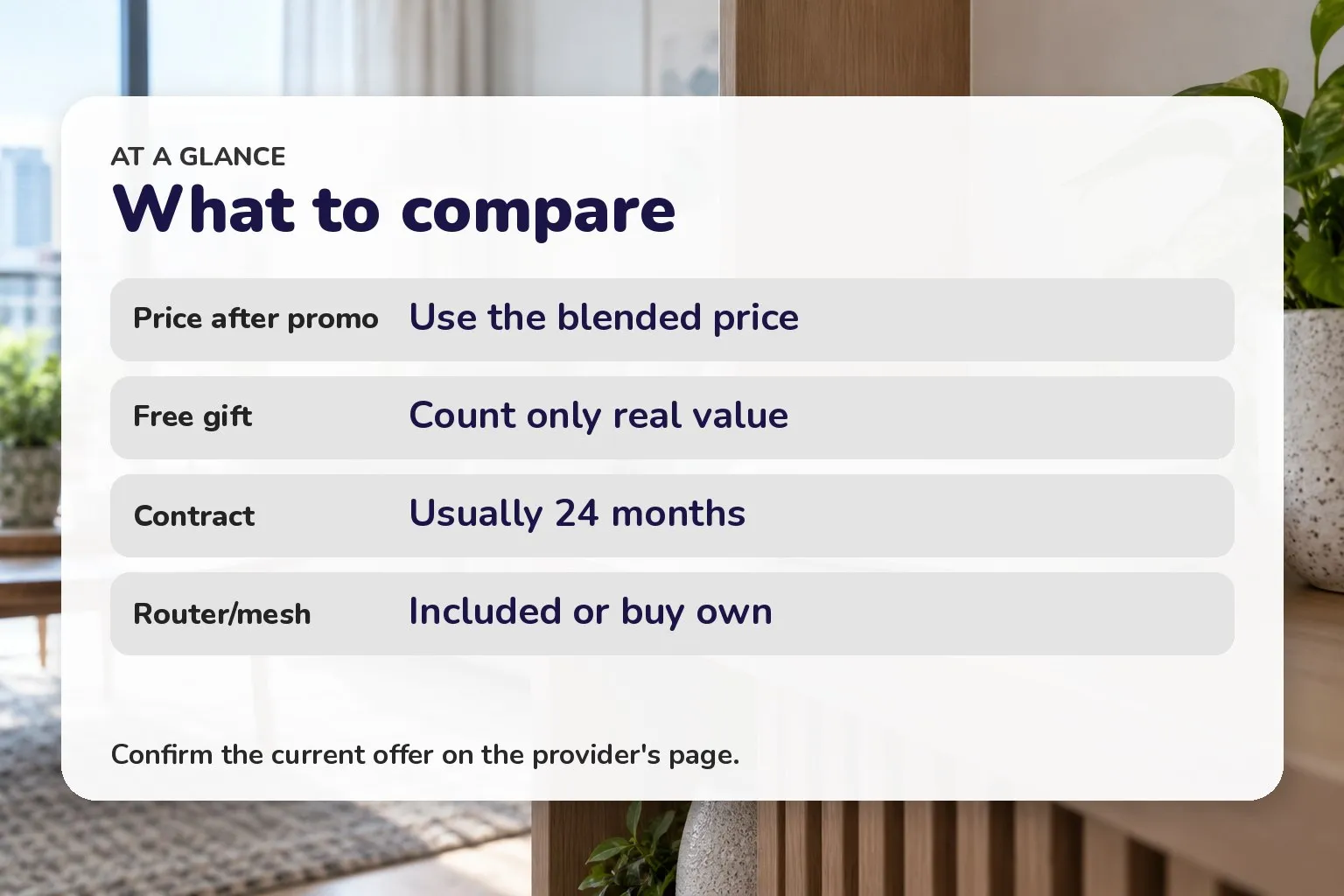
How to compare broadband plans.
- Add up all monthly charges over the full contract (blend any promo and post-promo prices).
- Add any mandatory one-off fees and equipment payments, then subtract cash rebates and the gift’s value to you.
- Divide that total by the number of contract months to get the effective monthly cost.
| What to check | Why it matters |
|---|---|
| Price after promo | Many plans advertise a low rate that rises later; use the blended price. |
| Free gift value | A $400 “gift” you would never buy is not worth $400 to you. |
| Contract length | Usually 24 months; a longer lock-in for a small saving can backfire. |
| Router / mesh included | A bundled mesh system can save you a separate purchase — or be one you don’t need. |
| Early-termination fee | If you might move home or switch, check the exit cost. |
Are free gifts worth it?
Routers, tablets, TVs, vouchers and game consoles are common sign-up gifts. The honest way to value one is: what would I pay for this if it weren’t bundled? If the answer is “nothing”, the gift is worth nothing to you, and a cheaper plan with no gift may win. If it is something you were about to buy anyway (say a mesh router), count your actual avoided cost — capped at a realistic current street price, not the advertised RRP.
Illustrative example: Plan A is $40/month with a mesh router you’d otherwise buy for $200; over 24 months that’s $960 minus $200 = an effective $760, or about $31.70/month. Plan B is $34/month with a gift you don’t want; that’s $816, or $34/month. Plan A wins here only because you genuinely valued the router.
Router and mesh
The ISP’s bundled router is fine for small flats, but larger or multi-level homes often benefit from a mesh Wi-Fi system for even coverage. Sometimes buying your own mesh beats paying for the ISP’s — we compare the trade-offs in mesh Wi-Fi vs the ISP router.
A simple decision rule
- Confirm 1Gbps (or your needed tier) is enough — usually it is.
- Shortlist plans at that tier.
- Compare the effective monthly cost after gifts and promo step-ups.
- Check contract length and exit terms.
- Only pay for a higher tier or a big gift if you will genuinely use it.
If your telco also offers mobile, check whether bundling mobile and broadband beats buying each separately. Plans and gifts change often — always confirm the current offer on the provider’s own page, and see how we track plan prices.
Sources
- IMDA — telecommunication services and consumer information — Infocomm Media Development Authority (as of October 2026)
- IMDA — Nationwide Broadband Network — Infocomm Media Development Authority (as of October 2026)