Open Electricity Market Singapore, Explained Simply
The Open Electricity Market lets households buy electricity from a licensed retailer instead of at the regulated SP tariff. Your actual power supply does not change — SP Group still runs the grid and delivers it. Switching is entirely optional.
On this page (6 sections)
The Open Electricity Market (OEM) simply means you can choose who you buy your electricity from. Before OEM, every household bought electricity at the regulated tariff set each quarter and billed through SP Group. Now you can instead sign a plan with a licensed retailer — but your physical electricity, and how reliably it reaches you, does not change at all.
What changes and what doesn’t
Here is the part that confuses people: switching retailer does not change your power supply. As the official consumer advisory states, SP Group continues to operate the national power grid and deliver electricity to you regardless of which retailer you choose. The same wires, the same reliability, the same power. What can change is your price plan, contract terms and billing arrangement — depending on the retailer, you may be billed directly or through SP Group.
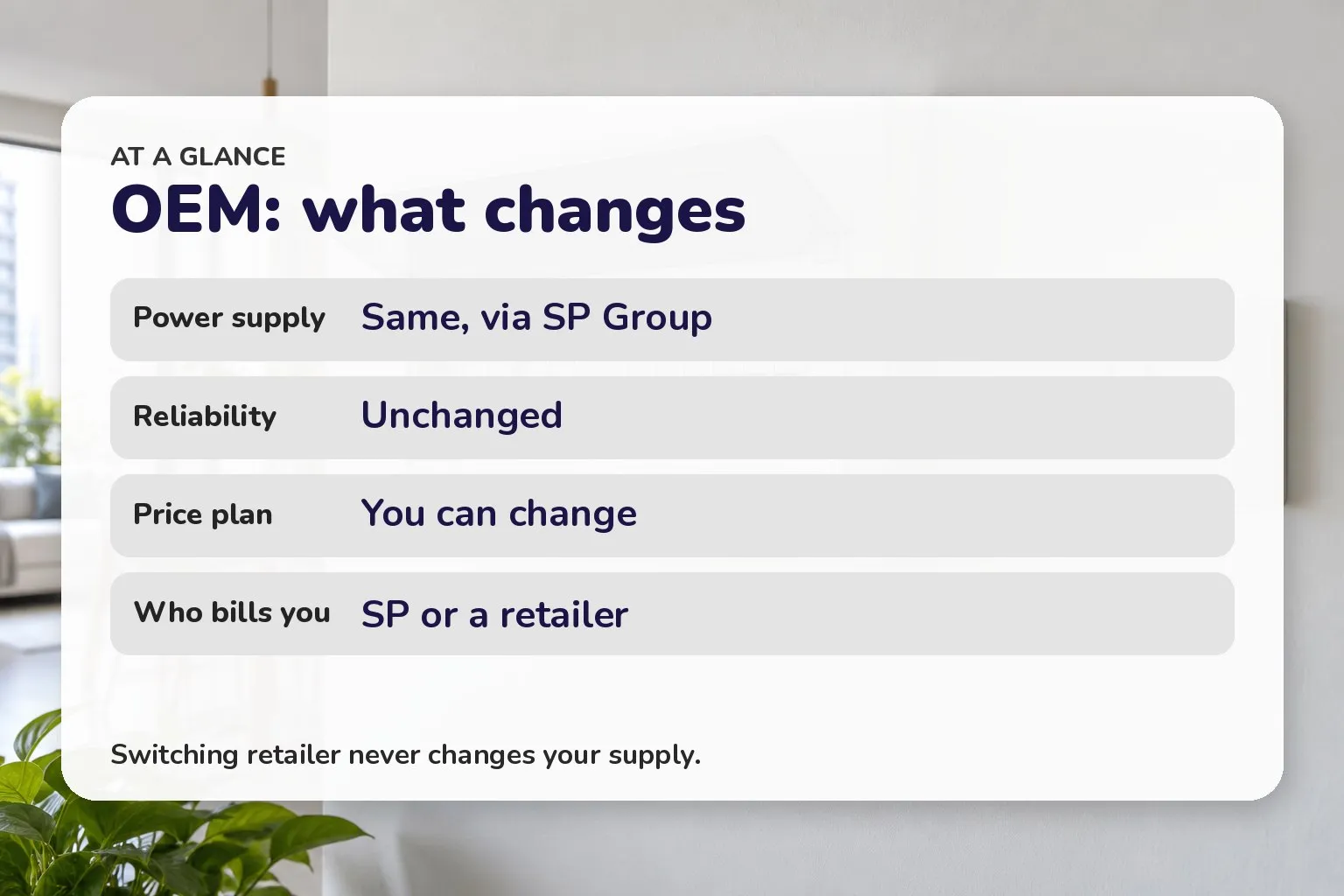
What the Open Electricity Market does and doesn’t change.
| Stays the same | Can change | |
|---|---|---|
| Physical electricity supply | ✓ delivered by SP Group | |
| Grid reliability | ✓ unaffected | |
| Price per kWh | depends on your plan | |
| Who bills you | SP Group, or a retailer (directly or via SP Group) |
Switching is optional
Two official points worth repeating: switching to a retailer is not compulsory, and there is no deadline. Staying on the regulated tariff is a perfectly valid choice. If saving money is your aim, a retailer plan is only worth it if it costs you less than the tariff over the contract — so the tariff is your benchmark. Some households switch instead for price certainty, green-energy options or bundled perks.
The two standard plan types
Retailers offer two standard price plans:
- Fixed Price Plan — a constant rate for the whole contract (e.g. a set cents/kWh). It can end up higher or lower than the tariff, because the tariff is reviewed every quarter.
- Discount Off the Regulated Tariff (DOT) — a fixed percentage discount off the tariff, so your rate moves every quarter with the tariff but stays below it.
Which one suits you depends on whether you prefer certainty or always tracking below the tariff. Retailers may also offer non-standard plans with different pricing structures or recurring fees, and households can instead buy at the wholesale electricity price through SP Group — though that price can change every half-hour and is volatile. We compare the two standard types in fixed vs discount-off-tariff plans.
The regulated tariff is your benchmark
For 1 October to 31 December 2026, the regulated low-tension domestic tariff is 28.59 cents/kWh before GST, or 31.16 cents/kWh including 9% GST (SP Group). The tariff is reviewed quarterly, so it rises and falls over time.
How the regulated tariff moves
Looking at the recent quarterly tariff (before GST) shows why a “discount off tariff” plan is a moving target — and why a fixed plan can win or lose depending on where the tariff goes next:
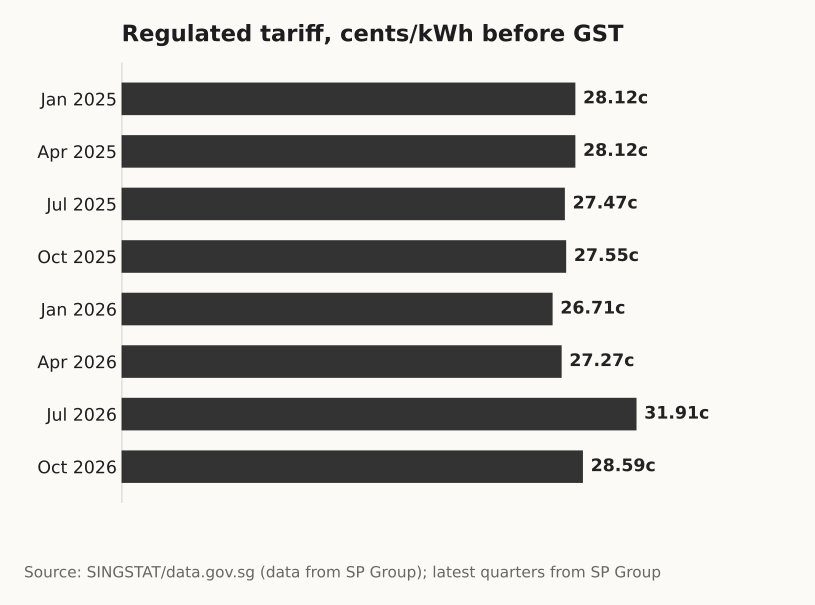
Singapore regulated low-tension domestic tariff by quarter, before GST. Source: SINGSTAT via data.gov.sg (data from SP Group); Jul–Oct 2026 from SP Group releases.
The tariff was flat in early 2025, generally declined into early 2026, rose modestly in Q2 2026, jumped to 31.91 cents in Q3, then fell to 28.59 cents in Q4 — exactly the kind of swing that makes the fixed-versus-discount choice matter.
Before you switch
The official advice is sound: read the plan’s Fact Sheet, check the contract length, any security deposit, auto-renewal terms and early-termination fees, and make sure a plan with automatic renewal offers a renewed rate below the tariff at renewal. We turn this into a checklist in how to choose an electricity retailer, and flag the common contract traps to watch for.
Always confirm current tariffs and plan terms on SP Group’s and the retailer’s own pages before deciding.
Sources
- Consumer Advisory: Signing Up with Retailers — Open Electricity Market (Energy Market Authority) (as of October 2026)
- Electricity Market overview — Energy Market Authority (as of October 2026)
- Electricity Tariff Information — SP Group (as of 1 October 2026)
- Electricity Tariff dataset — SINGSTAT via data.gov.sg (source: SP Group) (as of October 2026)